This post contains affiliate links. If you purchase through these links, I may earn a small commission at no extra cost to you. I only recommend products I genuinely believe in.
Notice what happens the next time you walk into a room that feels completely yours.
There’s a moment — subtle, almost invisible — where your shoulders drop half an inch. You didn’t decide to relax. Your body just did it for you. No thought required.
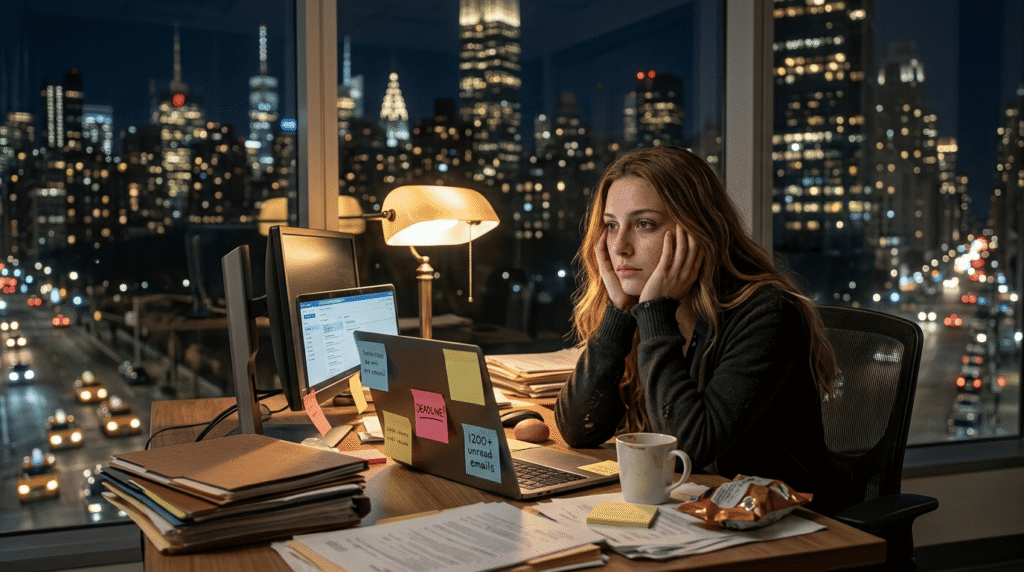
That involuntary exhale? That’s psychological safety. Not the workplace-meeting concept with frameworks and quarterly reviews. The older, quieter version: your nervous system recognizing, this is not a threat. And the reason it matters is that most of us spend the rest of our day in the opposite state — monitoring, guarding, performing fine — without even noticing we’re doing it.
What Psychological Safety Really Means (And Why It’s Not Just for the Office)
If you’ve heard the term before, it was probably in a team-dynamics context. Google’s Project Aristotle famously found that psychological safety was the #1 predictor of high-performing teams. Researcher Amy Edmondson defined it as “a shared belief that the team is safe for interpersonal risk-taking.” All valid. All useful.
But that framing misses something important: psychological safety isn’t a policy. It’s a physiological state.
Your nervous system doesn’t know the difference between social threat and physical threat. When you feel watched, judged, or like you have to be “on” — your body reacts the same way it does to danger. Cortisol rises. Muscles tighten. Your brain narrows its focus. That’s exhausting to sustain all day, every day, for years.
The good news is that the reverse is also true. Your nervous system can be taught to recognize safety. And unlike a workplace culture, you have direct influence over the signals that trigger it.
How Your Physical Environment Shapes Your Sense of Safety
Here’s something that tends to surprise people: your environment is in constant conversation with your nervous system, and it doesn’t wait for your permission to start talking.
Warm, soft light tells your brain it’s safe to rest. A familiar scent bypasses your analytical mind entirely and speaks directly to the limbic system. Certain textures, certain sounds, certain temperatures — they all carry information your body interprets before your conscious mind has even registered the sensation.
This is why you feel different in a cluttered, fluorescent-lit office than you do in a cozy corner with a lamp and a blanket. It’s not aesthetic preference. It’s biology.
What this means is that while you can’t always change your workplace, your relationship, or your city, you can change your corner. You can curate the sensory signals your nervous system receives when it most needs to hear: you’re okay now.
The Sensory Anchors That Signal “Safe” to Your Body
Sensory anchors are objects or environmental inputs that consistently trigger a calm, grounded response. The key word is “consistently” — the more you pair a specific sensation with intentional rest, the more reliably your body learns to downshift when it encounters it.
Think of it like training a reflex, but a gentle one.
Touch and pressure are among the most direct routes to a sense of felt safety. Deep pressure, in particular, activates the parasympathetic nervous system (the “rest and digest” counterpart to fight-or-flight). It’s why swaddling calms infants, why firm hugs feel stabilizing, and why so many adults find a weighted blanket quietly transformative. It’s not magic. It’s pressure applied consistently in a space you’ve marked as yours.
Scent works differently, and arguably faster. The olfactory system is the only sense with a direct line to the amygdala (the brain’s threat-detection center). Other senses get processed and filtered first; scent doesn’t wait. This is why a particular smell can transport you instantly — to your grandmother’s kitchen, to a place you felt safe, to a version of yourself that wasn’t exhausted. An aromatherapy diffuser running lavender or cedarwood in your designated corner can become, over time, an almost Pavlovian signal: this smell means you’re allowed to stop.
Light is the most underestimated element. Overhead fluorescent light keeps the nervous system mildly alert — it mimics the sun-overhead quality of midday, which your biology reads as “time to be productive and vigilant.” Warm amber light, by contrast, signals evening. Safety. The body relaxes without being asked. A Himalayan salt lamp isn’t wellness theater. It’s a low-cost way to shift the physiological register of a room.
Sound as a Safety Cue — The Overlooked Anchor
Most people curate what they see in a space meant for calm. Far fewer think intentionally about what they hear.
Your auditory system is always on. Unlike your eyes, which you can close, your ears continue processing the environment even when you’re trying to rest. Unexpected sounds, intermittent voices, the background hum of a busy household — all of it keeps your nervous system gently scanning for threat. That’s its job. But it means genuine downshift is nearly impossible in an acoustically chaotic environment.
This is where a white noise machine earns its place. It’s not about silence (silence can actually feel unnerving to people used to noise). It’s about creating a consistent sonic boundary — a predictable sound backdrop that tells your brain: nothing unexpected is coming from that direction. You can stop scanning. You can rest.
For those who don’t have a quiet room at home, or who need to build emotional safety into a commute or open-plan office, a wearable anchor solves a different problem. A discreet fidget ring carries that grounding cue on your body. You don’t need the corner or the lamp. You have something consistent, something yours, on your hand.
Building Your Personal Safe Zone — It Doesn’t Have to Be a Whole Room
The phrase “safe space” can conjure something inaccessible: a dedicated meditation room, a quiet studio apartment, a life with more square footage. That’s not what we’re talking about.
A safe zone is a corner. A chair. A specific spot on your couch at a specific time of day. Size is not the point. Consistency is.
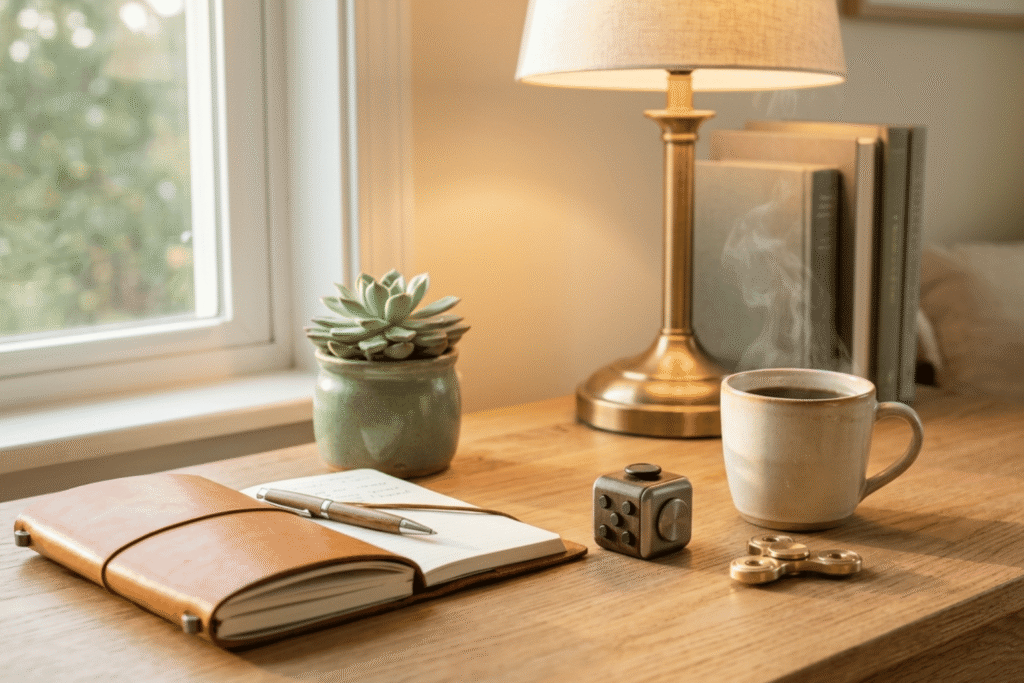
The way it works: you choose a spot, anchor it with 2–3 sensory cues (a lamp, a scent, a texture), and you show up there repeatedly during moments that aren’t crisis moments. You’re training the association when the stakes are low, so it’s available to you when the stakes feel high.
Five elements are enough to build something real:
Light — Warm, low, amber. Swap the overhead for a lamp or a salt lamp in that corner only.
Texture — Something to hold or sit under. A weighted blanket, a chunky knit throw, even a favorite mug.
Scent — One consistent scent used only in that spot. Even a single tea ritual can work if the smell is reliable.
Sound — White noise, soft music, or deliberate quiet if your home allows it.
A single comfort object — Something that has no purpose except to feel good in your hands. Objects without “productivity” attached to them carry a particular kind of permission.
If your home doesn’t feel safe, this still applies. Make it small. Make it portable. A fidget ring in your pocket, a scent on your wrist, earbuds with your one trusted playlist. Psychological safety has a wearable version, too.
You Can’t Control the World — But You Can Control Your Corner
We spend a lot of energy waiting for conditions outside us to become safe enough that we can finally relax. A better boss. A quieter house. A calmer season of life.
Sometimes those things come. Often they don’t, or not when we need them most.
What you can do, right now, is change the signal. Shift one input. Add warmth to a corner of your home. Give your hands something consistent to hold. Let a scent train your body to recognize one reliable moment of safety in each day.
It doesn’t solve everything. It doesn’t have to.
Start there. Your nervous system will notice, even if the rest of life is still chaotic. That involuntary shoulder-drop — the one from the very beginning of this article — can become something you engineer on purpose. A quiet signal you send yourself that says: for now, right here, you’re okay.
Frequently Asked Questions
Q: Can physical objects actually help create psychological safety, or is it all in your head? It’s in your nervous system, which is much harder to override than your thoughts. Touch, scent, light, and sound send signals directly to the parts of your brain that regulate threat response. Physical objects aren’t a placebo — they’re inputs your body uses to decide whether it’s safe to downshift.
Q: What’s the difference between psychological safety at work and psychological safety for yourself? Workplace psychological safety is about interpersonal trust: can you speak up without fear of punishment? Personal psychological safety is physiological: is your nervous system calm enough that you’re not constantly in low-grade threat mode? The two overlap, but you have far more control over the second one.
Q: I live with other people and there’s no quiet corner I can claim. What do I do? Go portable. A fidget ring, a personal scent on your wrist, and earbuds with white noise can create an internal safe zone even in a shared, noisy environment. The sensory anchor doesn’t have to be spatial — it can travel with you.
Q: Are weighted blankets actually useful for adults who don’t have anxiety? Yes. Deep pressure is calming for most nervous systems, not just anxious ones. After a long day of being “on,” most adults are running hotter than they realize. A weighted blanket doesn’t require a diagnosis to work — it just feels like being held, and that’s often enough.
Q: How long does it take before a space starts to feel genuinely safe? Neurologically, consistent pairing of sensory input with a calm state can build an association within 2–3 weeks of daily repetition. The key is using the space before you’re in crisis, not only when you’re desperate. Train the response when you don’t need it — so it’s available when you do.