
I used to be a master of the “Desk-Mask.”
To my colleagues in New York, I was the one who never missed a deadline. But under the desk, my hands were often shaking. I measured my worth by the speed of my Slack replies, and by 3:00 PM every day, my mind felt like a wire pulled so tight it was about to snap.
Maybe you’ve been there. That feeling when your chest tightens during a Zoom call, or when the “ping” of an email notification feels like a physical blow.
For years, I was told to “just breathe.” But when you’re in the middle of a high-stakes presentation, your brain doesn’t always want to listen to your lungs. What I discovered—and what truly saved my sanity—wasn’t a breathing app. It was a small, incredibly soft Taba Squishy.
What Exactly is a “Tactile Grounding Object”?
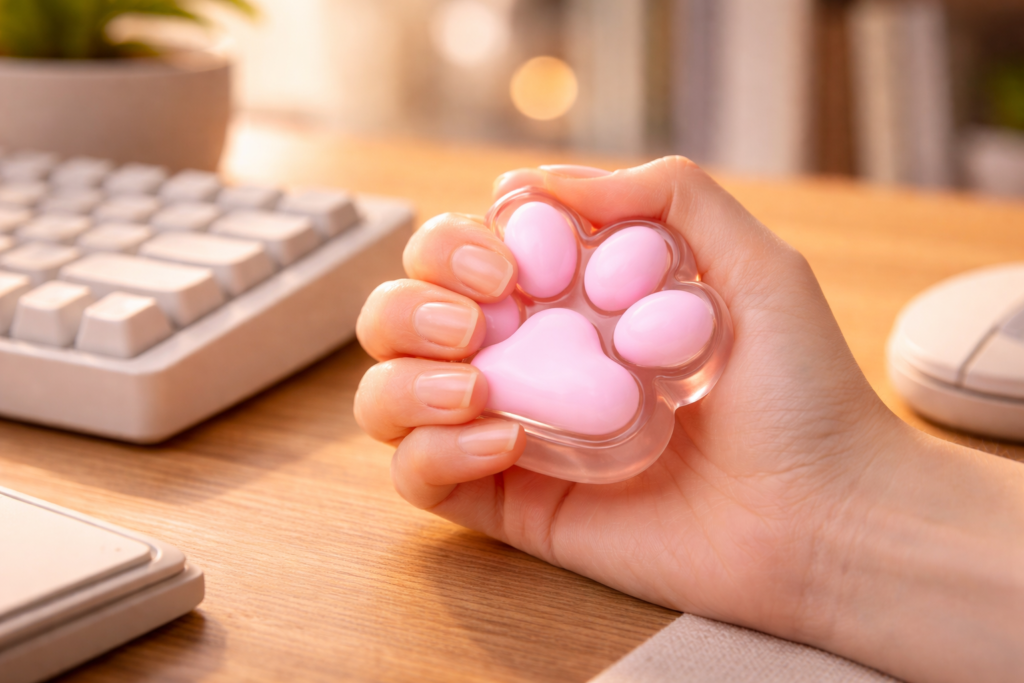
If you walked past my old desk in Manhattan three years ago, you would have seen a small, peach-shaped silicone squishy sitting right next to my high-end mechanical keyboard. To a casual observer, it looked like a child’s toy that had lost its way.
But to me, that wasn’t a toy. It was a Tactile Grounding Object.
Bridging the Gap: It’s Not a Toy, It’s a Tool
In our “always-on” corporate culture, there is a strange stigma around having something “playful” at your workstation. We are expected to be stone-cold professionals, fueled only by caffeine and KPIs.
However, a Tactile Grounding Object bridges the gap between a simple toy and a therapeutic tool. While a toy is designed for distraction, a grounding object is designed for connection. It’s a sensory anchor. Its sole purpose is to provide a specific physical sensation—be it coolness, weight, resistance, or texture—that demands your brain’s attention when your thoughts start to spiral.
The Science (Simplified): Breaking the “Freeze” Response
Have you ever felt so overwhelmed by a project that you just… stopped? You stare at the screen, your heart races, but your fingers won’t move. In psychology, this is often called the “Freeze” response.
When you are under intense stress, your amygdala (the brain’s alarm system) takes over. It thinks you are being chased by a predator, so it shuts down your “logical” brain to save energy for survival. You aren’t lazy; your brain is just stuck in a loop.
This is where the tactile magic happens.
When you pick up a weighted fidget or press into a cold, slow-rising Taba Squishy, you send a “Priority 1” signal to your nervous system. That physical sensation—the cool touch, the deep pressure—acts like a Hard Reset for your brain.
It tells your amygdala: “Hey, look! We are right here, in this room, touching this safe object. There is no predator. We are okay.” By engaging your sense of touch, you bypass the mental noise and pull your brain out of the “Freeze” state and back into the present moment. You aren’t just “playing”; you are literally rewiring your stress response in real-time.
🌱 Sprout’s Sanctuary Tip: > “Grounding doesn’t have to be loud! I love objects with a matte, ‘soft-touch’ finish. They are silent during meetings but feel like a velvet cloud under your fingertips. It’s our little secret!”
My Top 4 “Sanctuary” Picks for the Corporate Office
When I curated this list, I looked for three things: discretion, durability, and what I call the “Squish-to-Peace Ratio.” These aren’t just items on a desk; they are the tools that helped me reclaim my focus when the “noise” got too loud.
1. The Taba Squishy: Why the “Cool-Jelly” Texture is the Ultimate Panic-Buster
If I could only keep one object on my desk, it would be a Taba Squishy. Unlike the cheap, airy foam squishies you find at big-box stores, a high-quality Taba is usually made of a dense, maltose-filled silicone that feels like heavy, cool jelly.
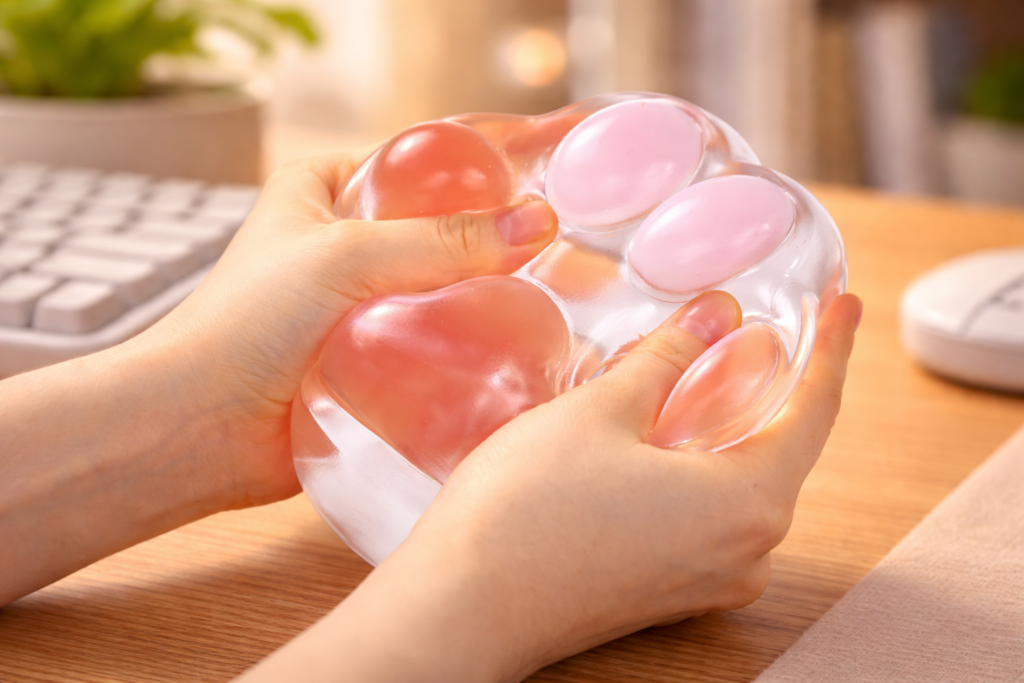
Why it works for anxiety: When a panic attack starts to bubble up, your body temperature often rises. The natural coolness of a Taba Squishy provides immediate thermal grounding. The “deep-pressure” resistance of the slow-rising maltose forces your hand muscles to engage, which tells your brain to stop spiraling and focus on the physical sensation in your palm. It’s like a “Stress-Reset Button” that fits in your hand.
2. Premium Metal Fidgets: Tools That Look Like “Desk Art” but Function as Focus Anchors
In a high-stakes boardroom, you might not want to pull out a bright pink squishy. That’s where Premium Metal Fidgets come in. These are weighted, precision-engineered kinetic sculptures made from stainless steel, brass, or titanium.
Why it works for the professional: To your boss, it looks like an expensive piece of modern desk decor. To you, it’s a silent, spinning, or sliding anchor. The weight is the key here. The gravity of a heavy haptic coin or a magnetic slider provides a “grounding” weightiness that is incredibly soothing for ADHD minds or those who need to “fidget to focus” during long presentations.
3. Textured Desk Mats: Constant Grounding Under Your Fingertips
Sometimes, you need grounding that doesn’t require you to “do” anything. Textured Desk Mats—made from premium felt, vegan leather, or even topographical 3D fabrics—provide a constant tactile horizon.
Why it works for “Passive Healing”: By simply resting your forearms or palms on a textured surface while typing, you are receiving a continuous stream of sensory data. It prevents that “floating” feeling of dissociation that often comes with high-stress digital work. It defines your Desktop Sanctuary as a physical space that is distinct from the digital chaos on your screen.
4. Nook Books: A 5-Minute Visual and Physical Escape into Another World
On the days when the office walls feel like they’re closing in, I turn to my Nook Book (or Book Nook). These are intricate, miniature 3D dioramas that sit tucked between your books or files.
Why it works for the “Mindless Break”: Peering into a tiny, glowing library or a miniature Tokyo alleyway provides an immediate visual escape. Combining this with the tactile experience of building or adjusting the tiny pieces (I love sharing the 3D STL files for these in our Freebies section!) gives your brain a creative “palette cleanser.” It’s a 5-minute vacation for your soul without ever leaving your chair.
🌱 Sprout’s “Stealth” Tip: > “If you’re in a meeting where cameras are on, keep your Taba Squishy in your lap! You get all the grounding benefits without anyone knowing you’re squishing your way to calm. It’s our little office secret!”
Sprout’s Secrets: How to Ground Discreetly During Meetings
Let’s be honest: in some corporate environments, pulling out a bright squishy during a board meeting might raise an eyebrow. But your nervous system doesn’t care about office politics. Sprout and I have mastered the art of the “Stealth Grounding,” so you can stay calm without drawing a single eye to your hands.
1. The “Under-the-Desk” Anchor
Meetings are the ultimate stress test. I always keep a high-resistance Taba Squishy or a weighted Haptic Coin in my lap or pocket. By squeezing or sliding the object beneath the table, you are providing your brain with a “Safety Signal.” It’s a silent, powerful way to stop a racing heart while you’re nodding along to a presentation.
2. The Zoom “Off-Camera” Zone
The beauty of remote work is the “Hidden Space.” Your camera only sees your face and shoulders. Use the space right in front of your keyboard! I often have a Textured Desk Mat or a squishy just below the camera’s frame. You can look perfectly professional on screen while your fingers are getting the sensory input they need to keep you grounded and focused.
3. The Presentation Pocket-Trick
If you have to stand up and present, keep a small Worry Stone or a silent magnetic slider in your blazer or trouser pocket. Simply touching the cool, smooth surface of the stone during a difficult question can act as a “Reset Button” for your vocal cords, keeping your voice steady and your mind clear.
Building Your Own Desktop Sanctuary
Creating a Desktop Sanctuary isn’t just about buying pretty things for your desk; it’s about reclaiming your right to peace in a world that constantly demands your “Productivity”.
The Family Connection: Lessons from My & Den
I learned the true value of this mission from the two most important people in my life: my daughter, My, and my son, Den.
Watching them play, I noticed something profound. When they are stressed or overwhelmed, they don’t reach for a phone or a cup of coffee. They reach for something tactile—a stuffed animal, a block, a piece of clay. They naturally know how to “ground” themselves through touch.
As adults, we are told to “grow out” of play. We are taught that our hands are only for typing and our minds are only for solving problems. But My and Den taught me that “play” is actually a form of deep respect for our mental health. By allowing ourselves these small, sensory moments at work, we are telling our bodies: “You matter more than this deadline.”
When I named this sanctuary Mydentoys, I did it to honor that childhood wisdom. I want to help you build an office space that feels less like a cage and more like a garden.
Ready to start your healing journey?
Visit the Sensory Lab to see the specific tools Sprout and I have tested for the modern professional, or head over to the Healing Hub for our latest free desktop organizers and mindfulness checklists.
Stay soft, stay mindful.— Dianna Adams